§1 Introduction
The Pine language, Niṡkullit, sometimes called by its anglicised endonym Nishku or Nishlit, is a language isolate spoken in Niṡkuvut (anglicised as Nishkuvut or simply Pineland). [...] This book aims to give a formal and detailed description of the language as it has been standardised and as it is spoken by its native speakers.
[...] The ancestors of the modern Pine people are believed to have lived somewhere in Europe towards the end of the last ice age. They may have originated from a Paleolithic population of a glacial refugium (with likely admixture with other refugia populations, such as proto-Basque populations), likely west of the Ural mountains, and may have had early contact with proto-Uralic speaking people. The proto-Pine population likely migrated across an ice bridge to the island of Niṡkuvukki. They have been the sole permanent inhabitants of the island for thousands of years, in relative isolation. Some evidence exists that there was early contact with populations from Europe sometime before the 10th century – most likely Irish monks, whose use of Ogham may have given rise to the Pine writing system, Tuġvut. Additionally, a handful of placenames contain the element ƛan- or ƛam- (ammaġat, anƛủ, ammun) which have been proposed to be cognates with ƛummi 'reindeer that has shed its antlers' or ƛammulit 'bald', possibly in reference to Irish tonsures. Some traditional stories mention wandering hermit-like characters known as ƛadnikki (sg. ƛadnit) said to have the ability to commune with the natural world. Many have linked their name to ƛammi or ƛammulit and interpreted this as a reference to tonsures of Irish monks.
[...] Very little sustained cultural exchange occurred between Pine people and the rest of the world until the eighteenth century, when the Danish crown was expanding and consolidating its powers in the North Atlantic. Niṡkuvut was never formally incorporated, but Danish presence established itself against vigorous opposition by Pine people and gradually grew through trade outposts and largely unsuccessful Lutheran mission efforts. Pine communities entered into various trading agreements that resulted in a semi-autonomous position not unlike that of Greenland and the Faroe Islands, although Pine people fiercely defended their independence and resisted forced modernisation. By the mid-eighteenth century, Denmark claimed protectorate status over Niṡkuvut, largely on paper and through mercantile ambitions rather than military control. Denmark attempted to grant authority to local chiefs of certain communities who sought to control and encourage trade advantageous to Denmark, but most commerce went on as it always had.
As Danish interest in Niṡkuvut waned due to the opposition of its local population, the crown eventually withdrew its claims to Niṡkuvut, and Niṡkuvut was declared an independent nation on June 22nd 1888, Pine's independence day. Cultural and economic relations between Niṡkuvut and Denmark remained on good terms, and the influence of the short-lived Danish protectorate on Pine culture remained significant. However, Niṡkuvut was slow to develop its own forms of government and relied heavily on a de facto Danish model, which was ineffective and not widely accepted within Niṡkuvut. Parallel to this de facto model, Niṡkuvut gradually developed and implemented its own administrative structures. Starting in the 1980s, Pine people looked to the establishment of the first Sámi parliaments in Finland, Sweden and Norway as models to establish the first Pine parliament and develop their own indigenous form of self-governance. In 1988, on the centennial of the independence of Niṡkuvut, the Gvaįįadda, or Pine parliament, was officially established. An official flag was adopted, the so-called Three-Pine flag or Tsůaƛƛůtġůttsat.
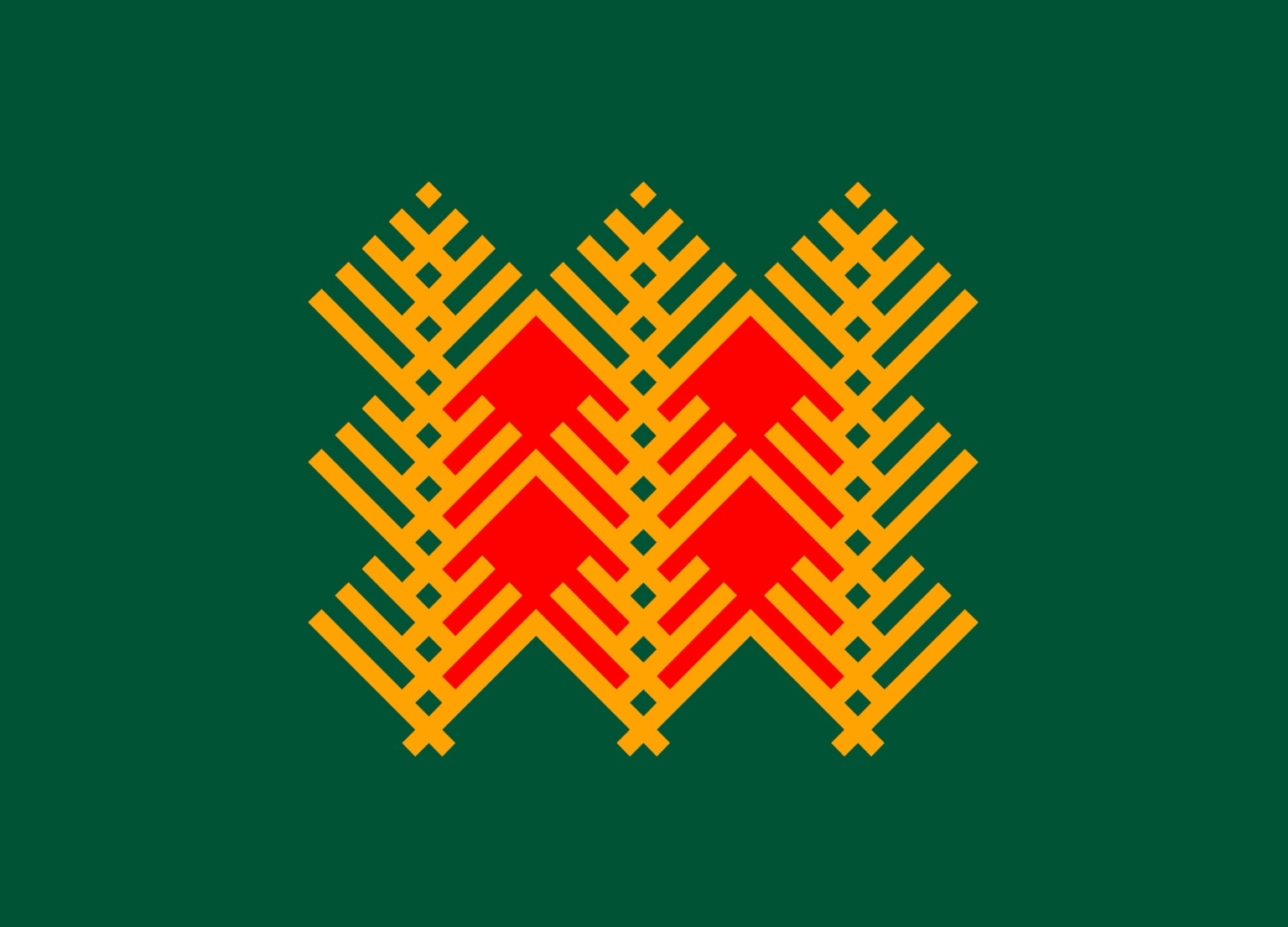
Tsůaƛƛůtġůttsat, or the Three-Pine flag – the official flag of Niṡkuvut. The three pines represent the three pillars of Pine culture: mỉtṇảmitta ('cultural knowledge'), mỉtṇảtůlġġa ('cultural skill') and ḷủlotůlġġa ('language skill'). The four red shapes represent the four main culturally distinct groups within Niṡkuvut: Northwestern, Southwestern, Northeastern and Southeastern groups.
Today, Niṡkuvut is a modern and progressive indigenous autonomous nation with a modern system of democratic governance and rich cultural and economic ties with the Nordic countries. Pine people have established especially close ties with Greenland and Sápmi [...].
[...] The natural landscape of Niṡkuvukki includes fjords, deserts, glaciers, extensive lava fields, numerous active volcanoes, and mostly uninhabited highlands. Along the coast, large boreal forests grow along fjords and bays. The island is home to some species otherwise only found in eastern North America, and common in northern Scandinavia. A significant portion of the island is taiga, with large populations of reindeer and other game which the Pine people hunt, such as bears, (European) elks, deer, skunks, badgers, as well as a handful of reptiles, such as slowworms, adders, toads and turtles. Pine people have historically largely subsisted on reindeer hunting and herding. Fishing is also an enormously important part of Pine culture, especially trout and salmon. Seal and whale hunting has also been practiced, especially in the west and north where forests and taiga give way to tundra. The largest forests and lakes, and therefore the largest populations are concentrated in the east of Niṡkuvukki. Pine people today are still heavily dependent on fishing and hunting, and many still live a semi-nomadic lifestyle [...]
xxx